One of the most important decisions in a multilingual WordPress build is how different language versions are structured at a URL level. This is something we consider from the very beginning of both the design and development process, as it plays a major role in how search engines, like Google, interpret content, how effectively each language ranks in search results, as well as how easily users can find the correct language version of a site.
In practice, this comes down to how the different language variants are represented in the URL structure. The most common approaches are:
Subdirectories (e.g. example.com/fr/)
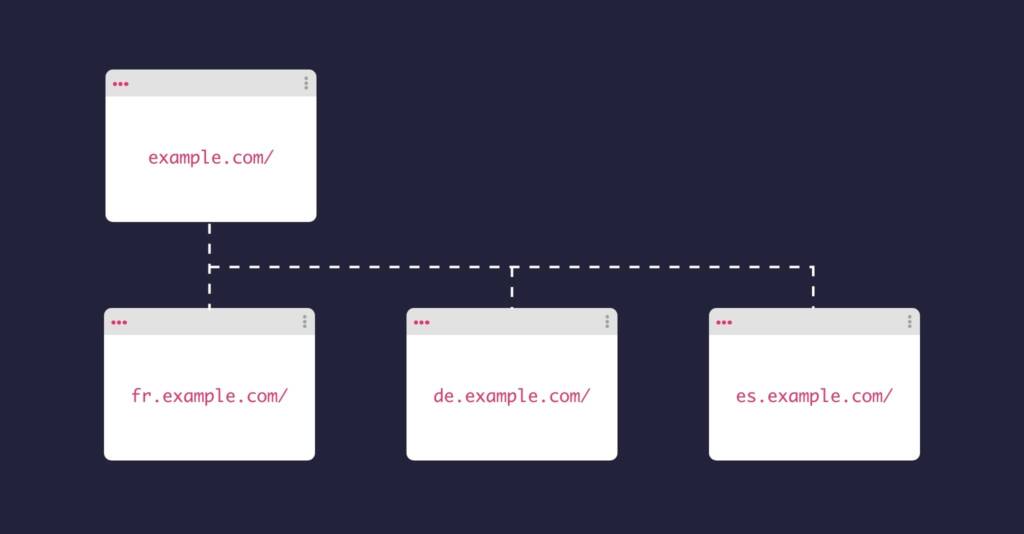
Subdomains (e.g. fr.example.com/)
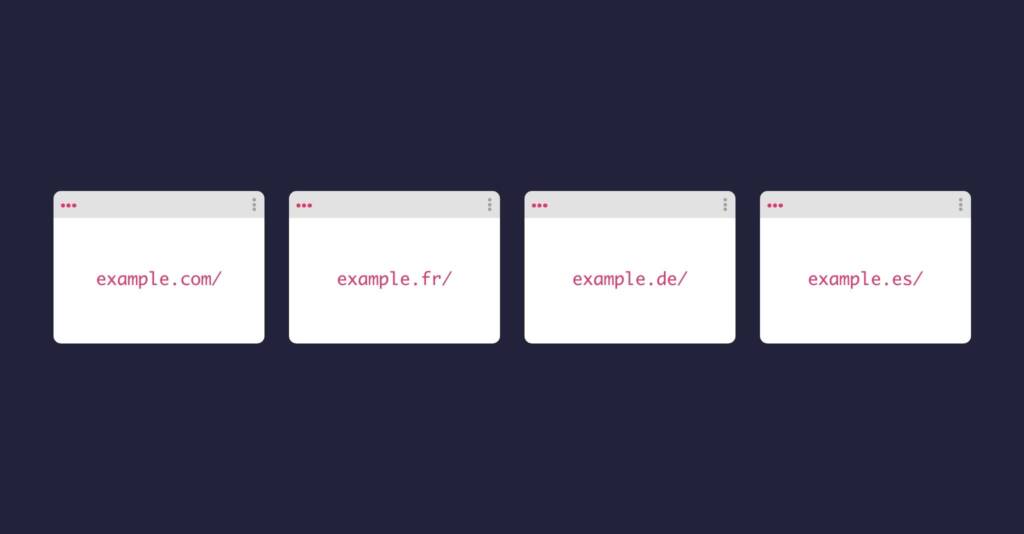
Separate domains (e.g. example.fr/)
Each option suits different organisational needs which we will explore.
Using subdirectories
Within a subdirectory structure, each language lives in a subfolder under the main domain, which means that all language versions are hosted under a single domain name.
For example:
example.com/fr/
example.com/de/
example.com/es/
From an SEO perspective, this approach is often the most popular one. This is because all language versions sit under one domain, meaning that they benefit from the pre-existing authority, trust and backlink profile that the main domain has already built over time. This can help any new language versions gain visibility much more quickly, compared to other URL structures like subdomains, making it perfect for expanding into new markets.
As well as this, from a marketing point of view, a subdirectory structure can also make it easier to analyse data and measure performance. This is because traffic, engagement, and conversions for all languages can be viewed within one analytics property on most tracking platforms, centralising data for all language variants.
Advantages
SEO authority is shared across all language versions
New languages can gain visibility more quickly
Centralised analytics and reporting
Consistent brand presence across languages (due to using the same main domain name)
Minimal DNS configuration required
Limitations
Less technical separation between the subdirectories from the main domain as all language variants are usually seen as part of the main brand (i.e. the main domain)
Can be restrictive if different languages require very different marketing and branding, so may be less suitable if language variants need to be positioned as semi-independent brands
Tracking each language variant separately may be difficult as most tracking platforms see all language variants as parts of one single website
When subdirectories are a good fit
Subdirectories are often well suited if:
Wanting to grow international visibility from an already established domain
Prefer a unified global brand
Wanting simpler reporting and tracking
For many multilingual websites, this approach offers the best balance between SEO performance and simplicity.
Using subdomains
On the other hand, with a subdomain structure, each language is placed on its own subdomain, which means that each language version of the site is essentially operating as a distinct section of the main domain.
For example:
fr.example.com
de.example.com
es.example.com
Regarding SEO, Google will often see subdomains as partially independent sites from the main domain. This means that, while these subdomains will still be seen as associated with the main domain, SEO authority isn’t shared as strongly compared to the subdirectory structure we mentioned previously. In this case, more work is then required for each language variant to build up strong visibility in search results.
For marketing teams, subdomains can create a clearer distinction between language sections which can be useful when regions are managed separately.
Advantages
Clearer technical separation between language versions
More flexibility for regionalised marketing, tailoring messages, campaigns and content for each language audience
Useful for when regional teams operate semi-independently
Easier to analyse each language or region separately which is useful for teams running separate campaigns per market
Limitations
SEO authority may be more fragmented across subdomains
Tracking platforms may see each language version as separate sites and so may track them independently from each other
More DNS management compared to subdirectories
When subdomains are a good fit
Subdomains are often suitable if an organisation:
Has separate teams managing different languages
Wants more independence between regions
Runs campaigns targeted at specific audiences
Needs clearer separation between markets
They are commonly used in larger or more decentralised organisations.
Using separate domains
With this approach, each language uses its own standalone domain.
For example:
example.fr
example.de
example.es
These are often referred to as country code top-level domains (ccTLDs) as these make use of domain extensions that are specific to each country (e.g. “fr” for France). This approach is commonly used for strong geographic targeting since Google sees each language operating as its own website for each region.
From a branding position, this approach can be very effective as local audiences tend to find country-specific domains more relevant, familiar and trustworthy.
As for SEO, this approach provides search engines the clearest signal about geographic focus. Both users and search engines can immediately understand exactly which country the site is targeting from the domain extension alone.
However, that being said, Google sees these language variants as completely separate sites. As there is no automatic sharing of ranking signals, this means each domain must build authority independently and each language version will need its own strategy to maintain visibility.
Advantages
Strong local branding and credibility
Clear geographic targeting signals
High level of control over regional content
Well suited to market-specific strategies and campaigns
Useful for when regional teams operate independently
Full separation in reporting and performance measurement for each language
Limitations
SEO authority from one domain is not shared to the other, they are completely separate
Each language runs independently which will need its own SEO strategy
Tracking and analytics cannot be centralised for all languages as they are seen as separate by most tracking platforms
More DNS management required compared to other approaches
Financial costs and admin required to purchase, renew and maintain multiple domains
When separate domains are a good fit
Separate domains are often best suited for organisations that:
Operate independently in different countries
Have dedicated regional marketing teams
Prioritise strong local branding
Have the resources to manage multiple domains
This approach is more commonly used by established international organisations.
Choosing the right structure
Subdirectories, subdomains, and separate domains are all perfectly valid and widely used approaches. When implemented correctly, each can support strong search visibility and a good user experience.
However, the choice of URL structure still has important implications for SEO, reporting, and long-term management. As mentioned, different setups distribute authority differently, influence how performance is measured, and shape how easily new languages can be added over time.
Identifying the right choice for a site’s URL structure will depend on many factors such as:
SEO goals and current domain authority
Whether different regions are being targeted with specific marketing campaigns
Whether regions will require independent branding
Internal resources and capacity
Analytics and reporting requirements
Long-term growth plans
So for example, a business with a centralised marketing team and a strong existing domain may benefit from consolidating authority under one domain name, this being the subdirectory approach. In contrast, an organisation operating independently in different regions with separate marketing teams may prefer clearer separation between language versions, such as the subdomain approach or even the separate domains approach.
What matters most is clarity and consistency. Once a structure is chosen, it should be applied uniformly across the site and supported by a clear internal strategy. Mixing approaches or introducing exceptions can complicate reporting, fragment visibility, and potentially make future expansion of languages more difficult.
Our verdict
URL structure for a multilingual site influences how SEO authority is distributed across the language variations, how performance is measured, and how easily multilingual content can grow over time. Making these decisions early allows them to be built directly into the site’s architecture.
At Wibble, with our technical SEO expertise, we design and develop multilingual WordPress websites with these considerations in mind from the outset. Having worked with all three approaches across different projects, we ensure that the chosen setup is implemented clearly and consistently into the site architecture.
If you are planning a multilingual WordPress website, we can help you design and build a setup that reflects these structural considerations and supports your long-term goals.
If you need help with a multilingual WordPress set-up, with a leading WordPress design and development agency, get in touch with Wibble.
Frequently asked questions about multilingual SEO
What is the best URL structure for a multilingual website?
There is no single “best” option. Subdirectories, subdomains, and separate domains can all work well when implemented correctly. The right choice depends on factors such as SEO goals, existing domain authority, internal resources, analytics requirements, and marketing and branding strategy for each language version.
Does using subdomains or separate domains hurt SEO?
Using subdomains or separate domains does not necessarily hurt SEO but each subdomain or separate domain must build SEO authority independently. This typically requires more ongoing effort regarding SEO strategy as ranking signals are not automatically shared across each language version in this case.
Can WordPress support all three URL structures (subdirectories, subdomains, separate domains) for multilingual sites?
Yes, WordPress setups can support subdirectories, subdomains and separate domains. However, each approach will require different technical configurations which we take into consideration when designing and developing a multilingual website.